
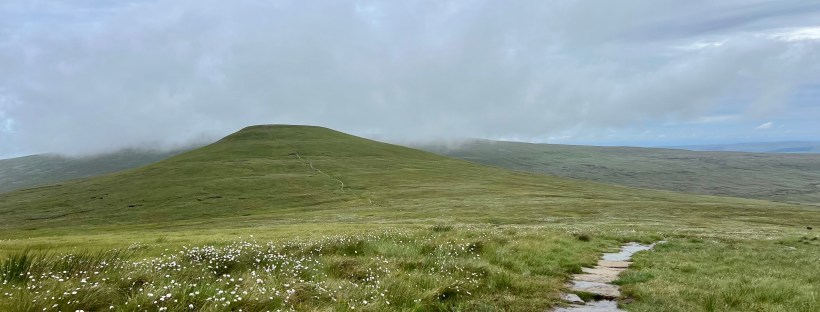
Waterfalls
As I’m about to leave, Ben from Fountains Fell is being kit checked. We catch each other’s eye & almost simultaneously ask if we fancy buddying up for the next section.
A weight quietly lifts.
As independent & self-sufficient as I am, I’ve been quietly worrying about tackling Falcon Clints & the scramble up Cauldron Snout alone, in the dark. Not wanting to sound weak, I hadn’t voiced my worry to anyone, except on the phone to the husband just minutes earlier. I could tell the conversation unsettled him more than it did me, so as Ben finishes his kit check, I send him a quick message to share my revised plan.
Ben & I set off together, easily picking up the conversation from where we’d left it at the foot of Pen-y-Ghent. He hasn’t been on this section of the Pennine Way before. I have & I know what lies ahead. It was the promise of this stretch that pulled me through those painful miles into Middleton.
The path meanders alongside the River Tees, just as it did before the checkpoint. We chat for the first mile or so, about photography, work, clients & the race. It’s natural, unforced. Ben pauses a couple of times to update his Instagram Stories, something I’ve consciously chosen not to do.
Before the race, I made a deliberate decision to disengage completely from social media. No Instagram. No Facebook. No posts. No stories. No WhatsApp groups. Nothing. I picked up one or two messages during the race. Everything else was ignored. Cut off from the outside world, I found a quiet clarity I hadn’t realised I needed.
The going is easy & we’re running well. This stretch of the Pennine Way is unusually flat, following the River Tees as it forms part of the boundary between counties. To our left, verges are awash with lush grasses, wildflowers & sheep. Fields rise gently towards distant hills, broken only by the occasional stone farm building. To our right, the river rushes past, wide & fast, its surface dark & restless, flanked by pockets of woodland.
We pass a sculpture of two life-sized stone sheep perched on a dry stone wall. “The Sheep”, by local artist Keith Alexander, stand sentinel over the path, as if quietly judging those who pass beneath them.
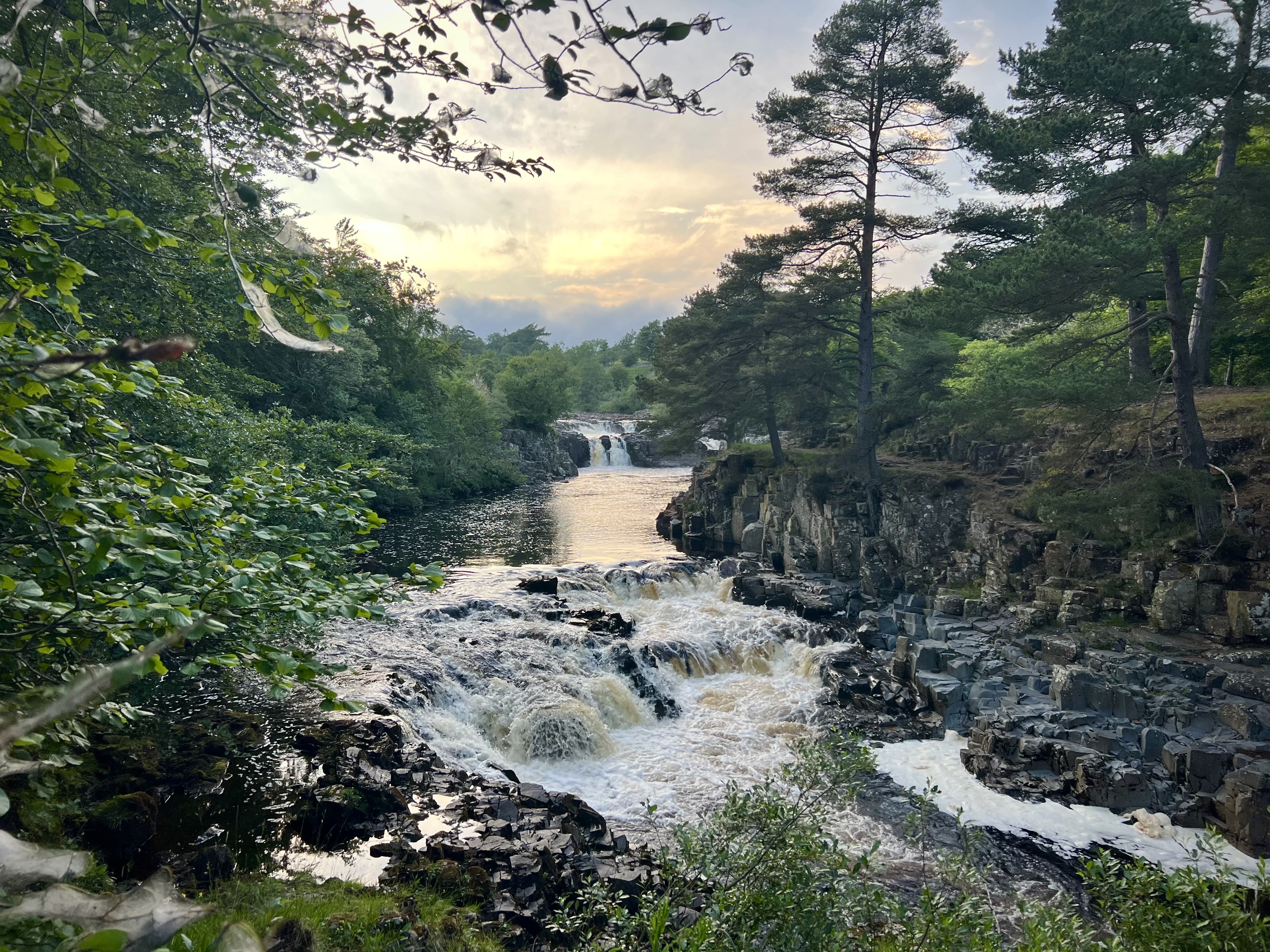
Low Force
I hear Low Force before I see it. A low, constant thunder carried on the air. The first & perhaps least dramatic of the waterfalls along this stretch of the Tees, it still demands attention. We pause as the river spills over the Whin Sill, folding itself into white water & spray. At eighteen feet high, it’s only a prelude.
A mile further on, the sound deepens, grows heavier, until it vibrates in my chest. High Force reveals itself suddenly, England’s most powerful waterfall plunging over an unbroken seventy-foot drop. The volume is staggering. The water doesn’t fall so much as hurl itself into the gorge below, relentless, unstoppable.
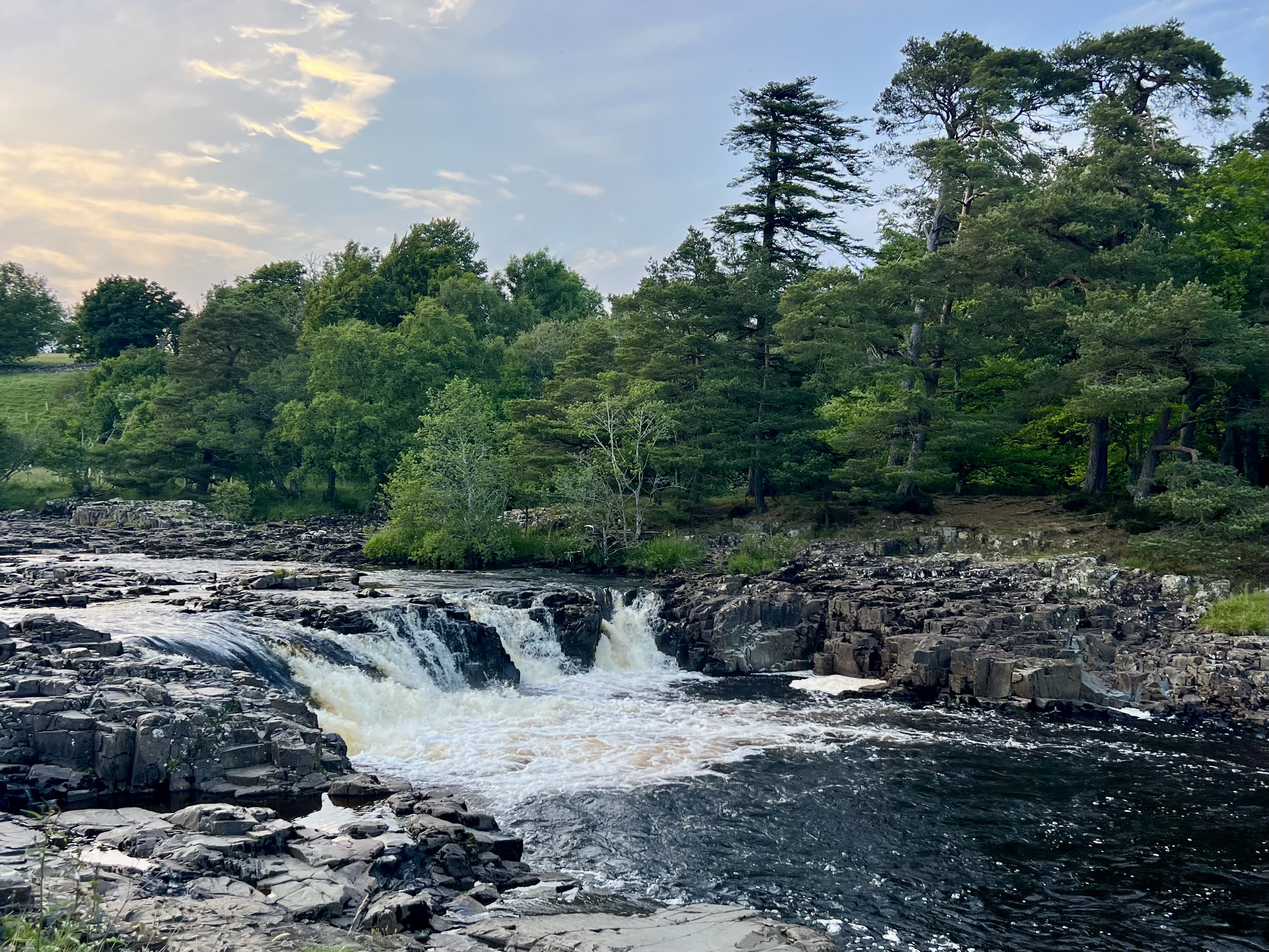
Low Force
The force of it is mesmerising.
Over time, it’s carved a narrow, dramatic chasm, the rock walls polished & gouged by centuries of erosion. It’s three days before the longest day of the year & just after 10 pm, yet there’s still enough light to see by. I guide Ben a few metres off the path to a small natural platform worn smooth by countless feet.
This is the spot.
We stand there in silence, watching the water crash into the pool below, mist rising into the cooling evening air. The noise fills everything, leaving no room for thought. I take out my phone, knowing full well it won’t do the moment justice, but some things need capturing anyway.
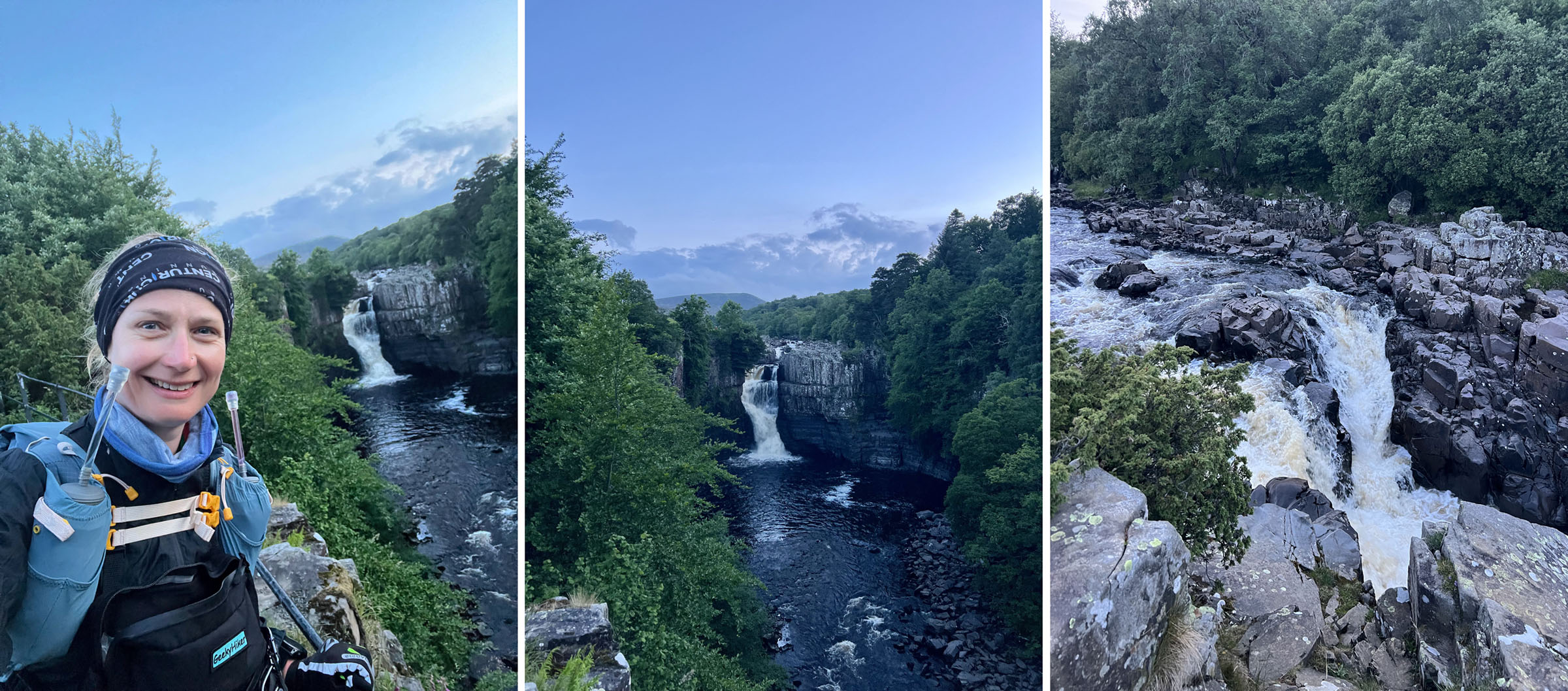
High Force
Reluctantly, we move on.
Upstream, the river narrows & calms, its fury temporarily spent. The path pulls away from the water to climb the first proper hill of the section. Rough & rocky, it feels like a return to the Pennine Way I know, a reminder that this gentler interlude was always going to be brief.
By 10:30 pm, we concede it’s time for head torches. I add another layer too, conscious that while the days are scorchingly hot, the nights cool quickly. I’m heading into night three on the Pennine Way.
After a few rises & dips across fields & meadows, the path crosses the river & follows Harwood Beck, crossing Windybank Pasture with its web of small springs. Boardwalks & flagstones guide us across streams as the path angles back towards the Tees, Falcon Clints looming ahead, dark & imposing.
Falcon Clints is a gorge carved deep into the landscape, towering rock faces rising sharply above the river. When I say path, I use the word loosely. Any trail that once existed has long since been swallowed by landslides, rockfall & scree.
This section was hard in daylight last summer. Now, at just past midnight, it’s pitch black. And aside from our head torches, completely dark.
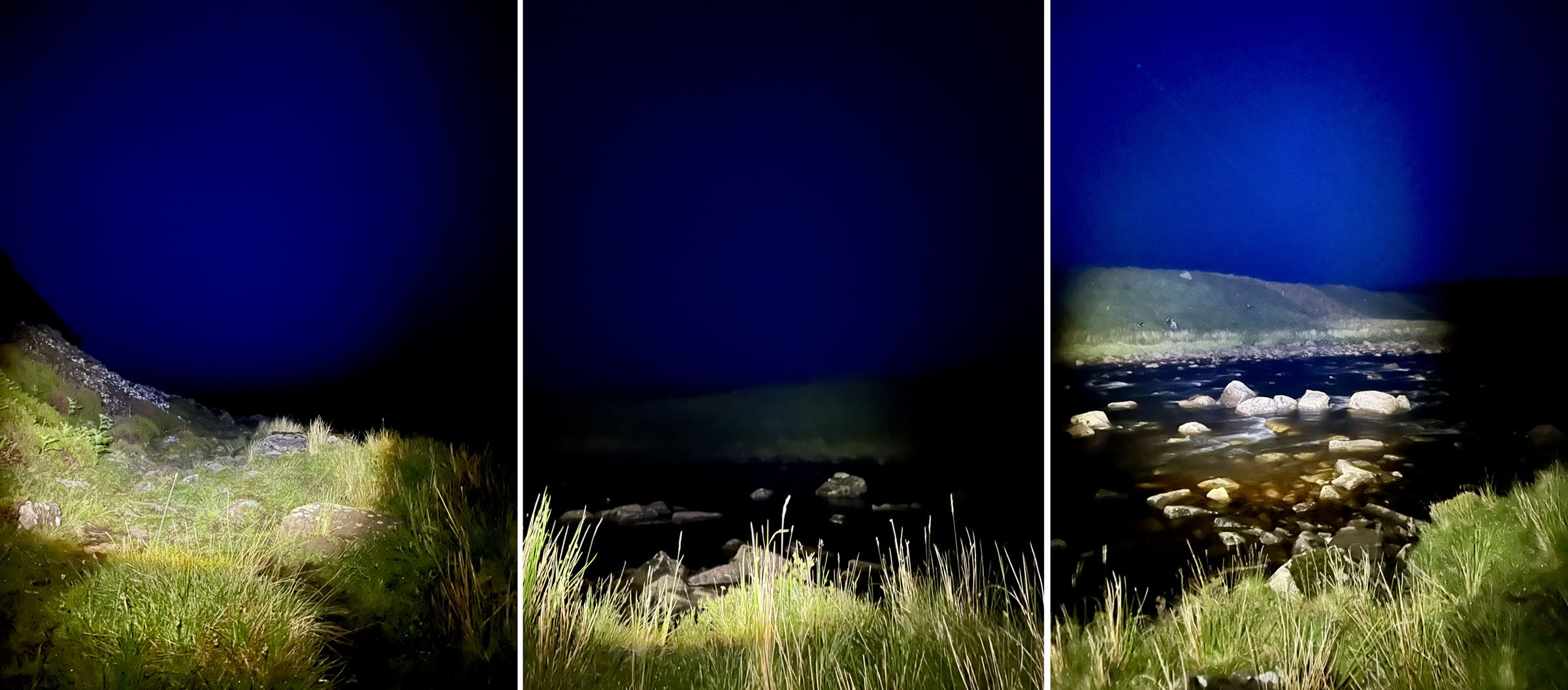
We move from boulder to boulder, each step deliberate, each foot placement considered. One mistake here would be serious. The river runs close, sometimes alarmingly so, its presence sensed more than seen. I stash my poles, preferring my hands free to haul myself over the boulders. This isn’t running. It’s barely walking. It’s wild, exhilarating, heart-beatingly terrifying & exactly the kind of adventure I came here for.
I’m grateful for Ben’s company. A fortuitous pairing. Away from running, he climbs & moves confidently across the rocks. He guides me through a particularly awkward section, calmly pointing out which rocks to trust.
It takes over an hour to cover barely a mile before we reach the foot of Cauldron Snout. I hear it first. A deep, thunderous roar tears through the stillness of the night.
Then the path turns & it’s suddenly there. An avalanche of water cascading down the hillside, fed by Cow Green Reservoir, spilling over the dam & crashing into the river below. In daylight, it’s impressive. In darkness, lit only by our head torches, it’s hypnotic.
Cauldron Snout isn’t about height. It’s about scale & power. A relentless series of drops tumbling around two hundred feet over six hundred feet of rock. Not one waterfall, but many, stacked one upon another, the water never resting.
A heady mix of fear, excitement, trepidation & adrenaline surges through me. The Pennine Way doesn’t skirt around Cauldron Snout.
It climbs it.
This is a four-point-of-contact scramble. Hands & feet, hauling myself up wet, slick rock as the water thunders just metres to my left. The noise is overwhelming, drowning out everything else. Spray coats the stone, making each move deliberate, cautious. I focus.
Right hand.
Left hand.
Right foot.
Left foot.
Pull.
Partway up, I stop & turn to look back. The sight stops me cold. A grainy photo doesn’t come close to capturing it, but I take one anyway.
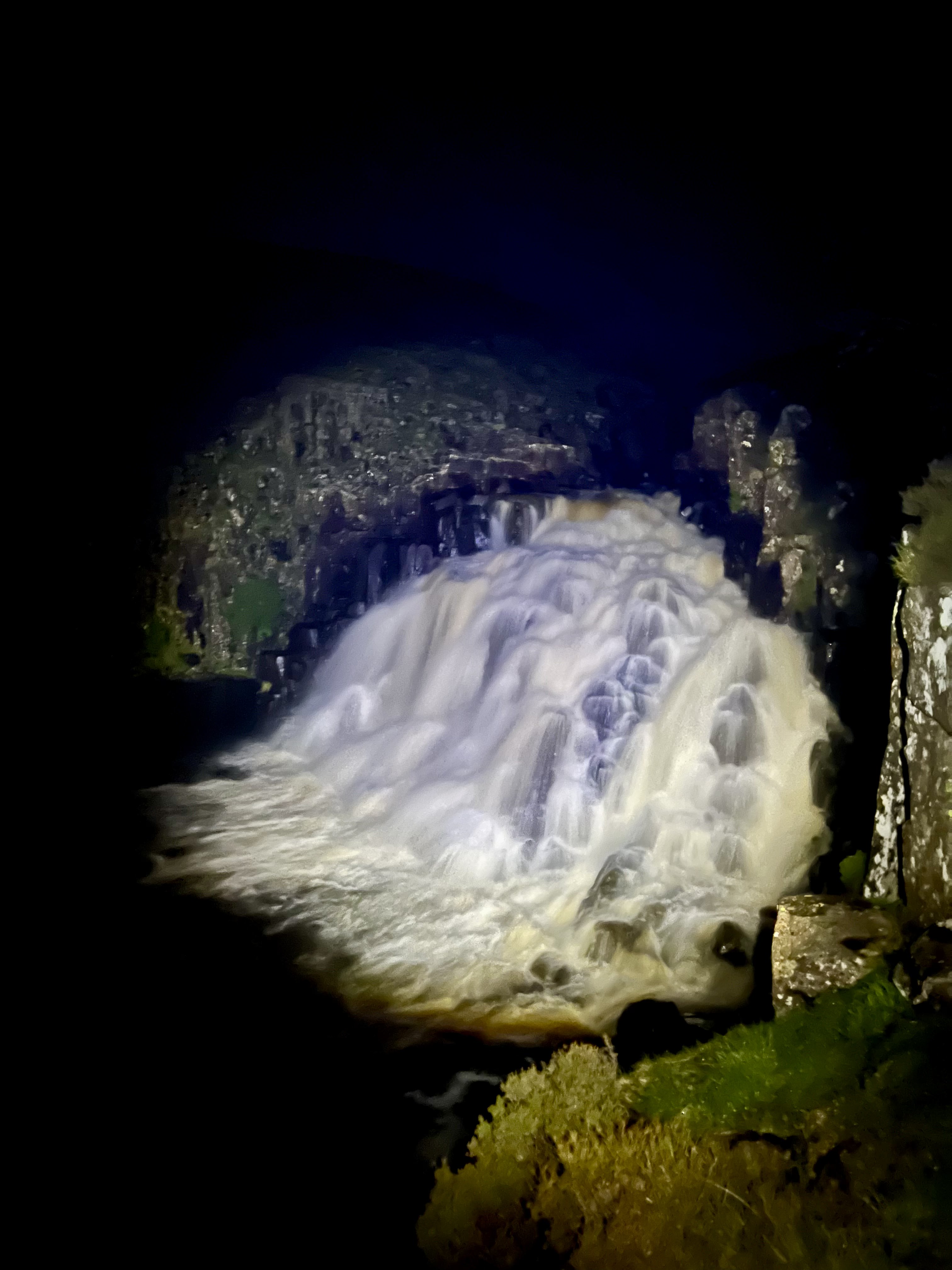
This is a Spine moment. One that will stay with me forever. Scrambling up the side of a roaring waterfall in the dead of night, guided only by the narrow beam of light ahead of me.
Beyond Cauldron Snout, the trail eases into a long gravel drag. Technically easy. Perfectly runnable. Just not now. Not after 150 miles.
The challenge shifts. Without technical ground to keep us alert, staying awake becomes the battle. Neither of us has slept more than a couple of hours since the start. Conversation fades. All energy is focused on forward motion & the only sound is the tap of poles on gravel. The night air bites & I add a fourth layer, double hoods, insulated gloves, still stubbornly in shorts.
At the Spine Starlink point, a temporary lifeline of connectivity, we pause, as instructed, to check messages. After several miles in the wilderness over Cauldron Snout, with no phone reception & no trackers, it’s a quiet reminder that someone at Spine HQ is checking up on us. Even out here, in the dark, we’re not entirely alone.
We push on. Keeping my eyes open is an effort now; I’m quite literally falling asleep on my feet. Without the intensity of the scramble to keep me alert, the tiredness creeps in, heavy & insistent. The gravel track eventually gives way once more to rough, rocky grassland as we begin the descent towards Maize Beck. We left the River Tees back at Cauldron Snout & its absence is felt, the landscape suddenly more open, less defined.
Underfoot, the ground is squelchy, not muddy, but unmistakably wet. Each step sinks just enough to demand attention, just enough to slow progress. I’m grateful for my waterproof socks, a small comfort that feels disproportionately important in this moment.
High Cup Nick, the next marker on my mental checklist, should be a highlight. Instead, it’s a quiet anticlimax. As we approach, there’s a faint wash of orange light smudged across the horizon behind us, the promise of dawn edging closer. But we’re too early. It’s still too dark to see anything properly.
Glacial in origin, High Cup Nick is a dramatic geological formation at the head of High Cup Gill, carved from the same Whin Sill as Low Force & High Force. An amphitheatre-shaped valley, vast & sculpted, the view is iconic.
In daylight.
Now, it’s just an idea. A shape hinted at rather than revealed. I don’t even bother attempting a photo.
The descent from High Cup Nick to Dufton is rough & unforgiving, a jumbled chaos of rocks of every size, remnants of the old quarry above, broken up by small streams tumbling towards the beck on the valley floor. There’s no rhythm to it, no easy flow, just careful foot placement & tired legs doing their best to cooperate.
Markers instruct us to keep right, though even in the half-light of early dawn it’s obvious why. To our left, the ground falls away sharply, dropping hundreds of feet. Cairns dot the route as reassurance more than necessity, the path so well worn that losing it would be difficult even in our sleep-deprived state.
Dropping down from Dod Hill, the sun finally lifts itself above the horizon behind us as the track merges onto tarmac. The sudden firmness underfoot offers brief relief to battered feet. After seeing no one since leaving CP3, we begin to cross paths with other Spiners, disoriented, dishevelled & equally hollow-eyed, all shuffling towards Dufton with the same singular purpose.
The night is finally behind us. It’s time for a rest.
Dufton
There is nothing in Dufton. No obvious reason for the surge of elation I feel as I enter the village. It’s somewhere around six in the morning. The café & pub won’t open for hours. There are no shops, nowhere to stock up on supplies, no checkpoint, nothing.
Nothing, that is, apart from the 24-hour public toilets, a tap & a covered bus shelter.
The Safety Team are waiting outside the shelter. A couple of runners are already camped out on the bench inside & the SST have managed to squeeze in a few extra camping chairs. Ben & I claim one each as someone phones HQ with our race numbers to let them know we’re stopping for a rest.
I am so tired that I don’t even bother getting my bivvy out. Instead, I unroll my bright orange emergency foil poncho, pull it over my head & curl up inside.
Sleep hits me immediately.
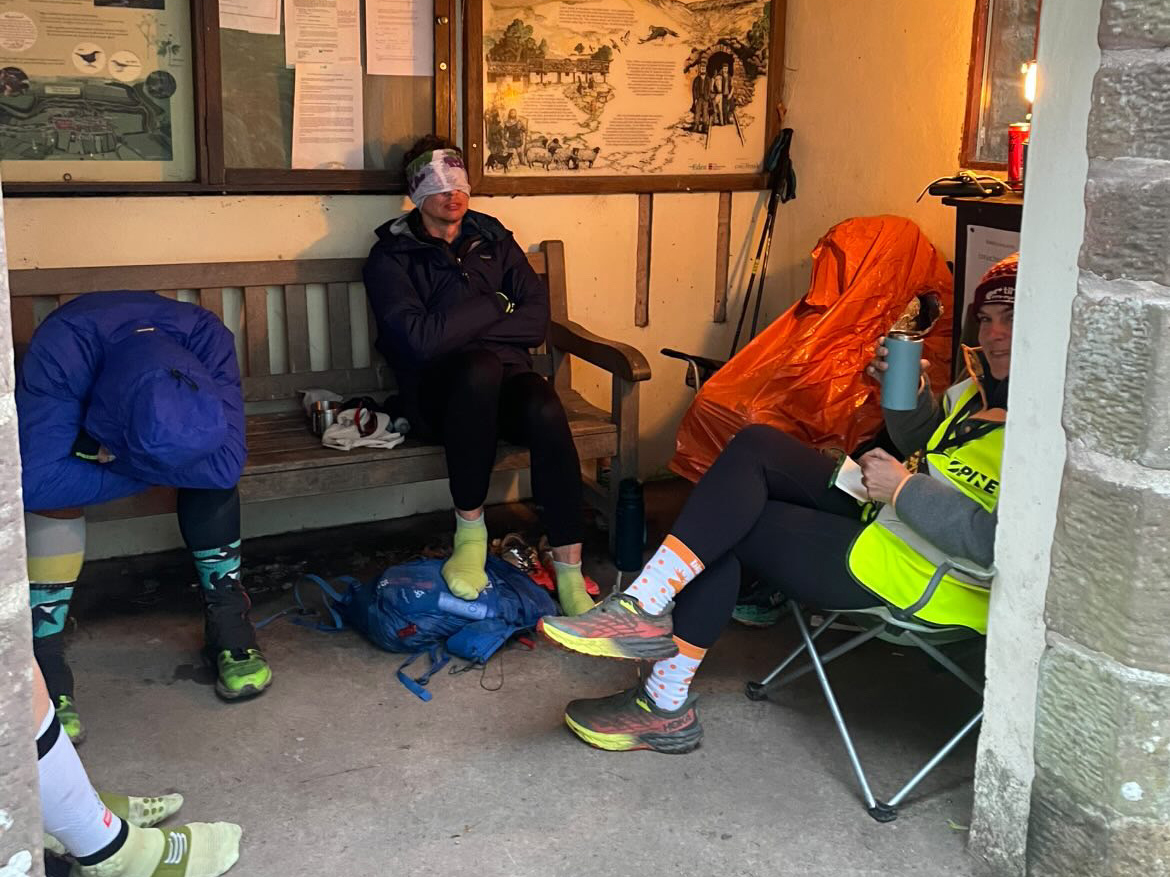
I’m the orange blob in the corner…
I say sleep hits me immediately. It does, but not for long. It’s not comforting sleep, nor is it restorative. I drift in & out of consciousness, dropping off & then jolting awake, momentarily unsure where I am or what I’m doing. Again. And again. And again.
I lose all sense of time. It feels like I’ve been huddled in that bus shelter for hours (post-race data tells a different story: less than two hours in the Dufton area), & I become convinced it’s time to move on. I ask Ben if he’s coming with me. He is.
While he pulls his shoes back on & packs away his bivvy, I head to the public toilets to freshen up. I wash my hands, rinse my face & clean my teeth. It almost feels like waking up in the morning & getting ready for the day ahead!
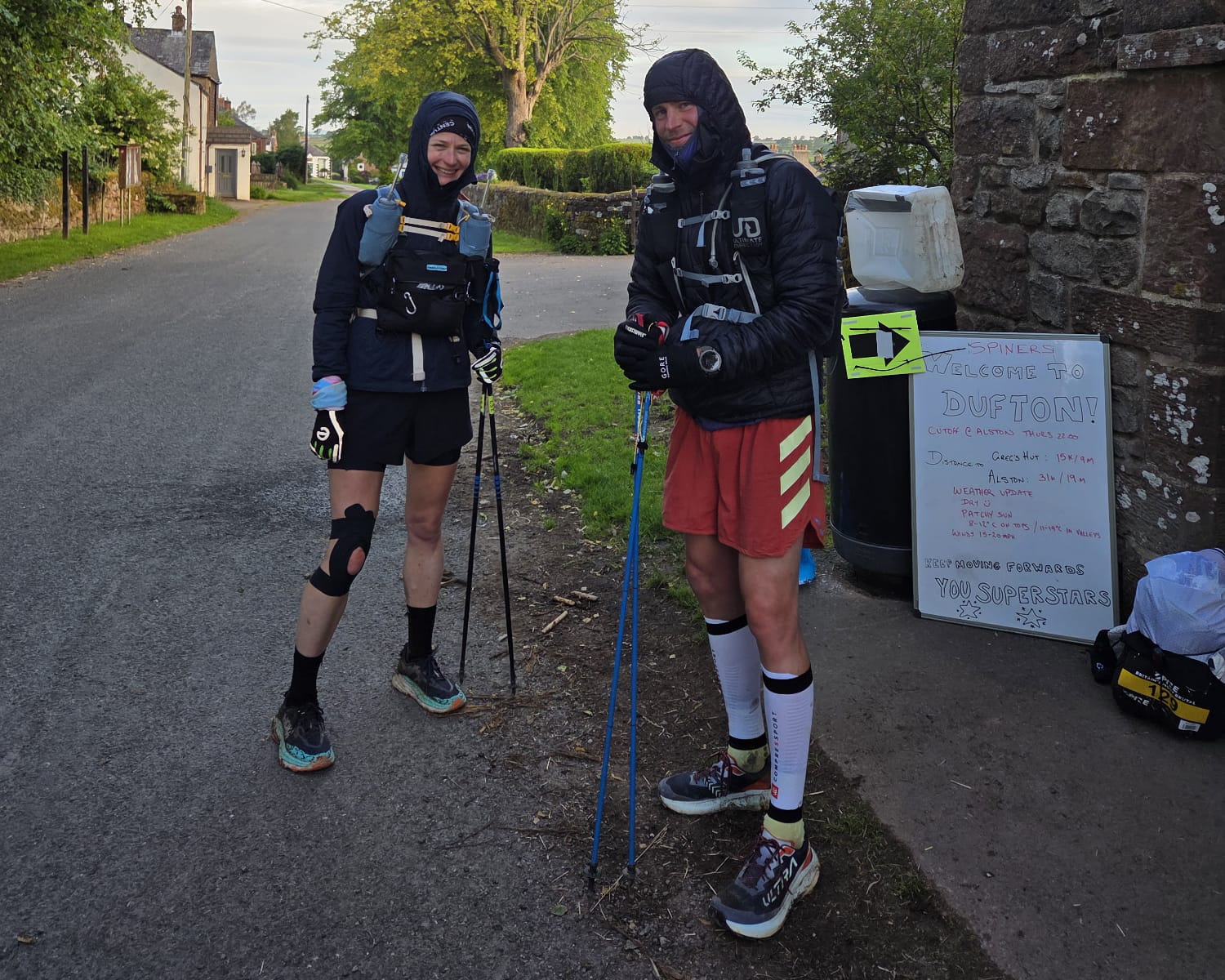
Ben & I ready to leave Dufton
Dufton, a pretty Cumbrian village with a population of only a couple of hundred, is still asleep as we wander through. It takes time to coax my legs back into motion. Thankfully, my knee seems to have held up over the technical ground; in fact, it didn’t bother me at all. Without the tape, I might even have forgotten about it entirely.
It’s roughly 20 miles to the next checkpoint at Alston.
But first, we have to conquer Cross Fell.
Knock, Great Dun, Little Dun & Cross Fell
Leaving Dufton is essentially one long climb. Around eight continuous miles of ascent to reach the highest point on the Pennine Way: Cross Fell. Before that, there are three other summits to contend with: Knock Fell, Great Dun Fell & Little Dun Fell.
We turn onto a gravel track, dry stone walls hemming it in on both sides as it threads through hedge-lined fields. It’s an old miners’ route, once used by men heading up to the small workings on the fells ahead. The mines are long gone now, leaving only the line of the track & a quiet sense of history beneath our feet.
The ground is rough & while initially nothing is aggressively steep, the climb is relentless. The path rises steadily, never offering any real respite. No drama. No flat sections. Just up.
I find a rhythm, leaning into my poles & pushing forward. It’s not fast, it certainly isn’t running, but it feels controlled & sustainable. That matters more now. As the day begins to warm, I shed my jacket & warm layers. I’ve lost any real sense of time, but the light has shifted & the chill of the night is finally lifting.
We pass through a farmyard that feels like the last outpost of civilisation. A final doorway before the hills close in. Beyond here, the Pennine Way between Dufton & Garrigill is perhaps the most remote stretch of the entire route.
Knock Pike rises to our left, Dufton Pike to our right, both lifting sharply from the land like pyramids. We cross a ford & clamber over a stile, leaving the gravel track behind. From here on, it’s classic Pennine terrain: rough, open grassland scattered with rocks, wild & untamed.
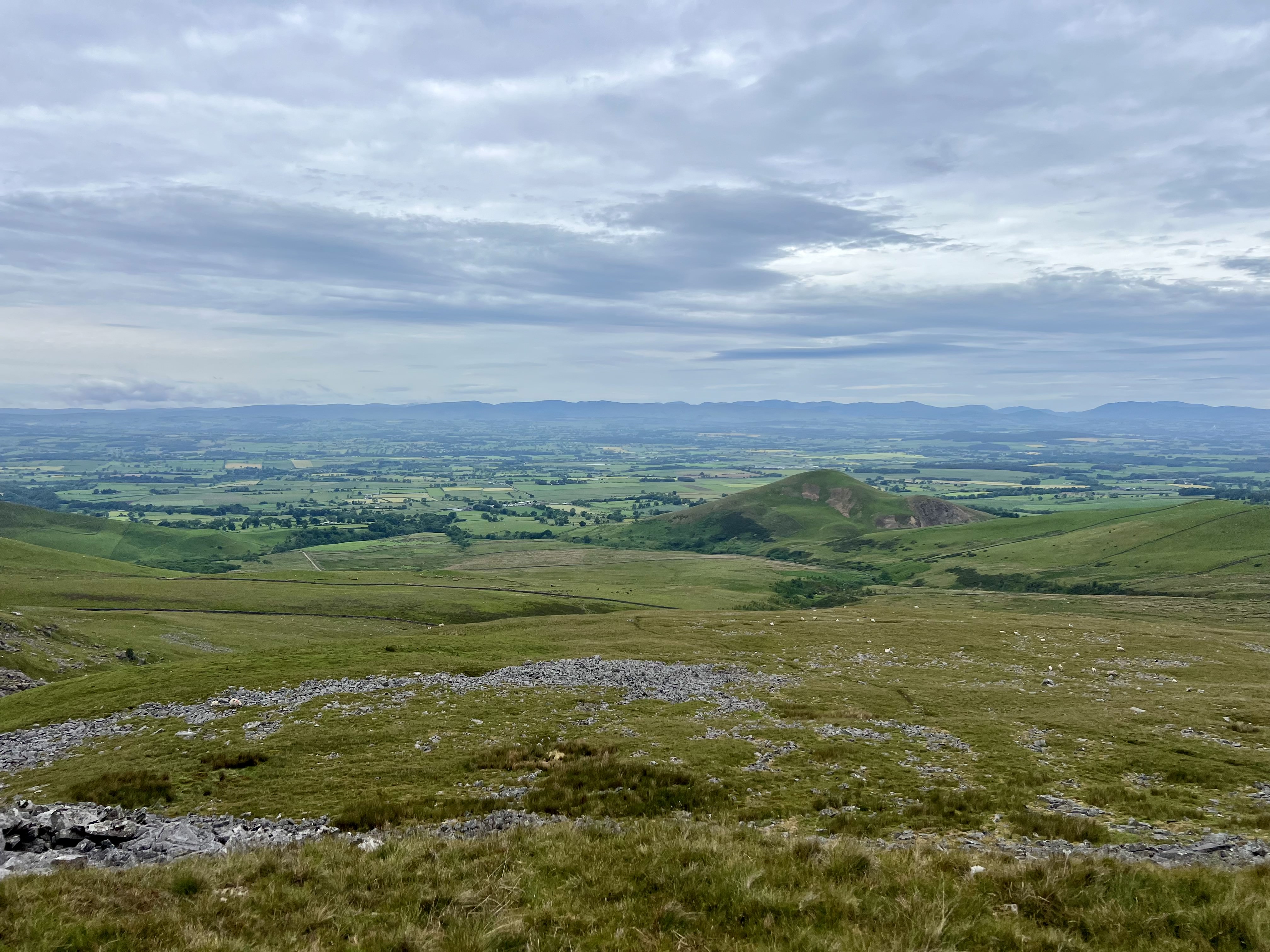
Streams & small rivers tumble down the hillside, carving steep little gorges into the earth. The gradient steepens & Knock Fell looms ahead. My eyes trace the path as it zigzags upwards, cairns marking the way. I watch the tiny figures of our fellow runners ahead inch their way skyward.
With his climbing & hill experience, Ben starts to pull away. Five metres. Ten. Twenty. A hundred.
At first, I try to stay with him. I’ve appreciated the company over the past twelve hours or so. It’s easier to keep moving when someone else is there, sharing the silence. But it quickly becomes clear that I’m working too hard. My heart rate, low & steady for days, now spikes. My legs burn. My breathing turns heavy & laboured. I’m not just uncomfortable, I’m on the edge of tipping over.
My mind drifts back to advice I received from a previous winter Spine finisher: run your own race. Focus on yourself. Don’t worry about what anyone else is doing.
It’s simple advice, but it’s surprisingly hard to follow.
I let Ben go. I watch him disappear up the hill until he becomes just another small figure moving steadily towards the skyline.
It’s back to me, myself & I.
I dial the effort back to something more manageable. My heart rate settles. My legs begin to feel like they belong to me again. I acknowledge how hard this is. Really bloody hard. The climb feels endless & simply continuing to move forward takes everything I have. There’s no spare capacity. No surplus strength. Just enough.
As I’ve done throughout the race, I set myself a mental marker. If I can just reach Knock Old Man, I’ll allow myself a rest. Knock Old Man is a distinctive, man-shaped stone cairn just below the summit of Knock Fell, the first of the four major fells. He stands there like a silent sentinel, waiting.
But the wind at the top has other ideas.
I try to shelter behind the cairn, but it’s bitterly cold & the wind cuts straight through me, slicing through sweat-damp layers. Stopping isn’t an option. After only a couple of minutes, fingers stiffening & core temperature already dropping, I’m forced to keep moving.
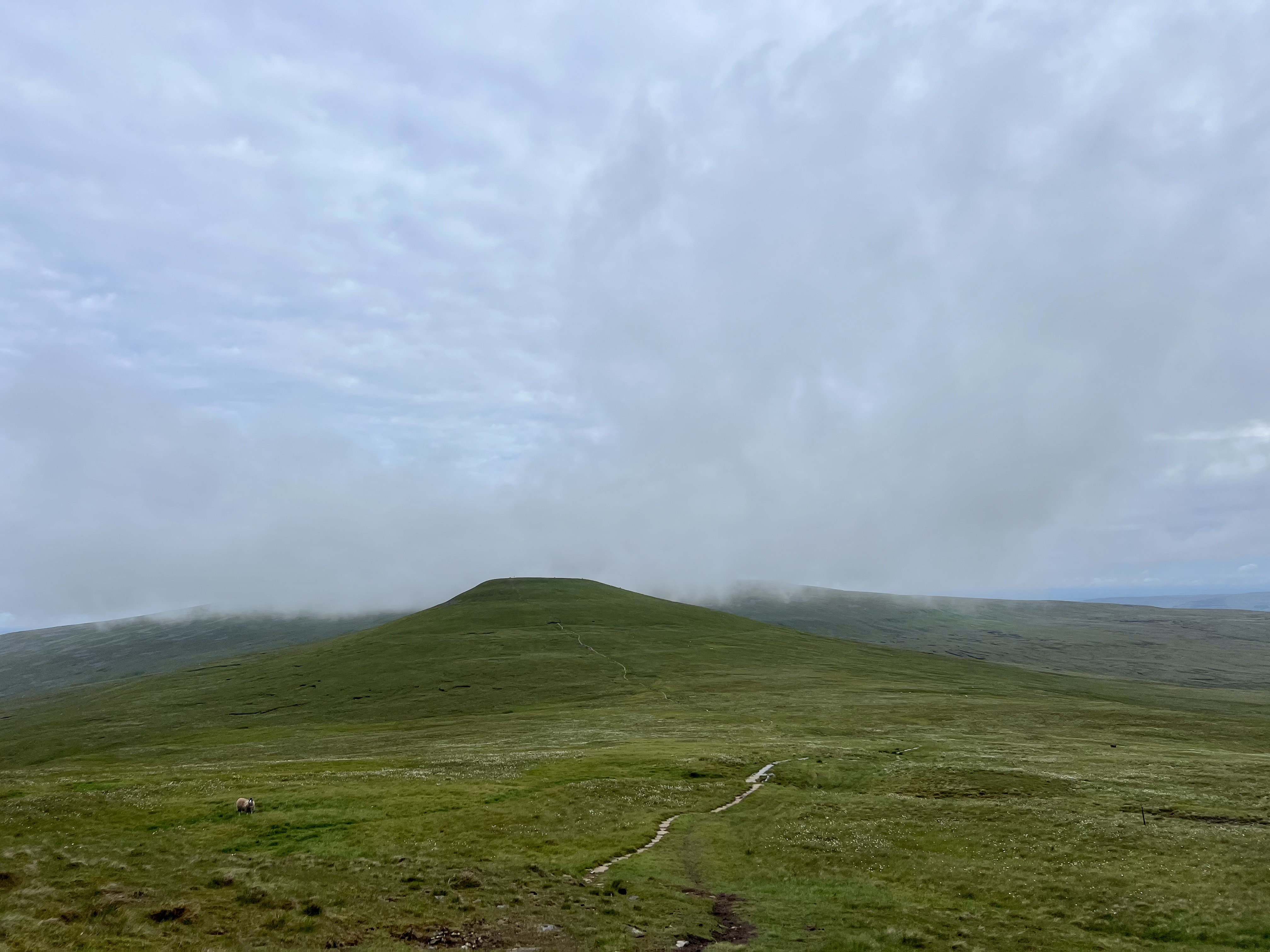
The wind stays with me as I cross Knock Fell & continue to Great Dun Fell, Little Dun Fell & finally, Cross Fell. Wind is not unusual here; I should have expected it.
This area has a uniquely harsh microclimate, often described as subarctic due to its altitude & exposure. Cross Fell is home to England’s only named wind: the Helm Wind, a powerful, cold north-easterly funnelled & amplified by the surrounding topography. It feels alive up here, as though the hill itself is pushing back.
After the struggle of Knock Fell, I start to move well again. Something clicks back into place. I make it a non-negotiable to run the flagstone paths linking the fells & for the most part, I do. It’s a small act of defiance. Beyond the slabs, the moorland is exposed & saturated, boggy even in the height of summer. I dread to imagine what this place is like in the depths of winter.
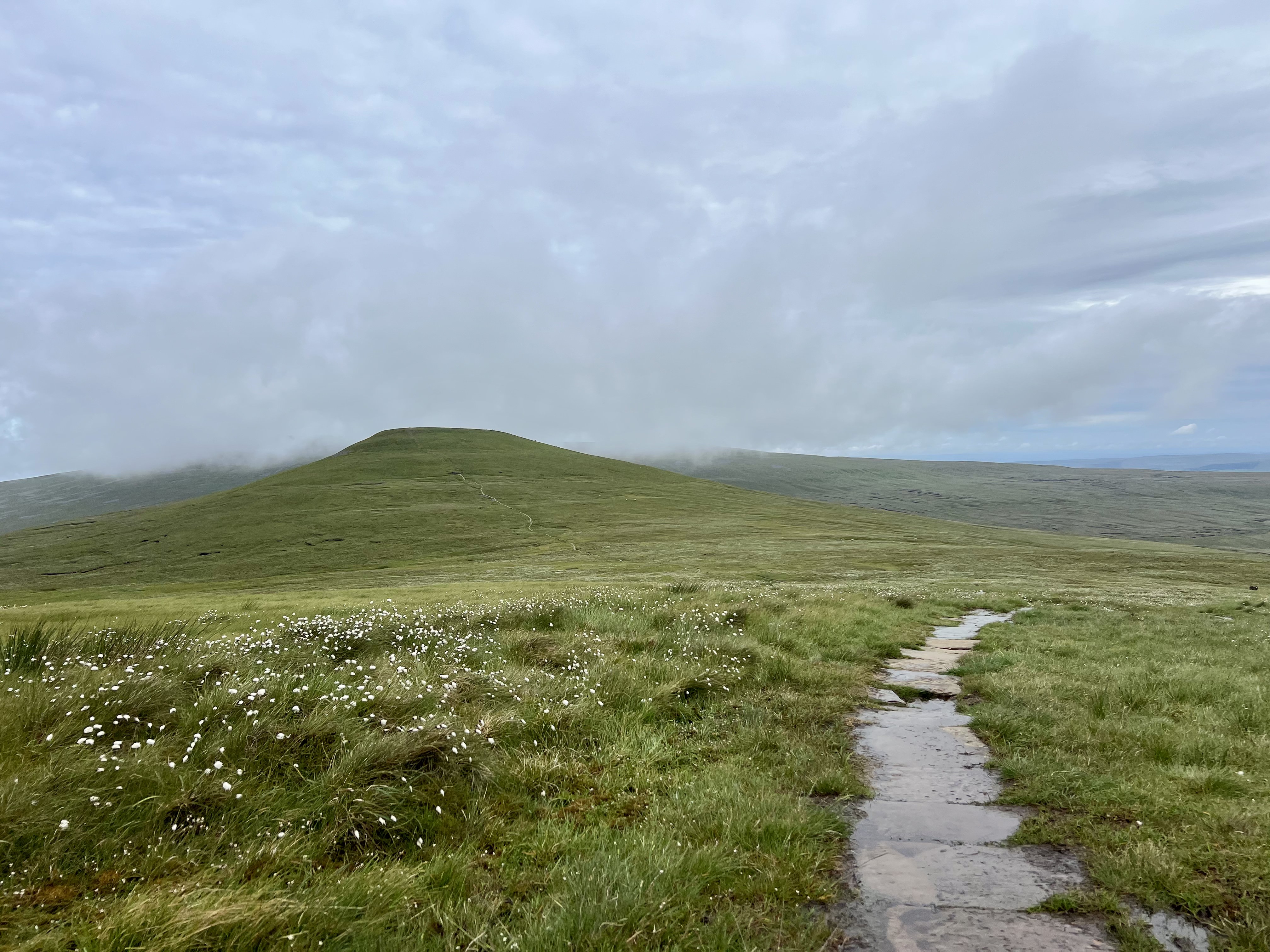
Cross Fell is iconic & I understand the significance of this part of the Pennine Way. I consciously try to take it all in. To absorb the sights, the sounds, the atmosphere. To imprint it somewhere permanent. But there is no great revelation. No surge of emotion. No cinematic moment.
I simply keep moving.
Eventually, I reach the summit of Cross Fell, the highest point in the Pennines. At the top stands an elaborate stone wind shelter, divided into quadrants. Several other Spiners are already hunkered down in the one corner that offers protection from the gale. I join them.
The difference behind the wall is immediate & astonishing. Silence. Stillness. Calm. Quiet. Relief. For the first time in hours, I am not bracing against anything.
I allow myself a few precious minutes to sit, to breathe, to exist without forward motion, before beginning the long descent to Garrigill & towards Checkpoint Four in Alston.
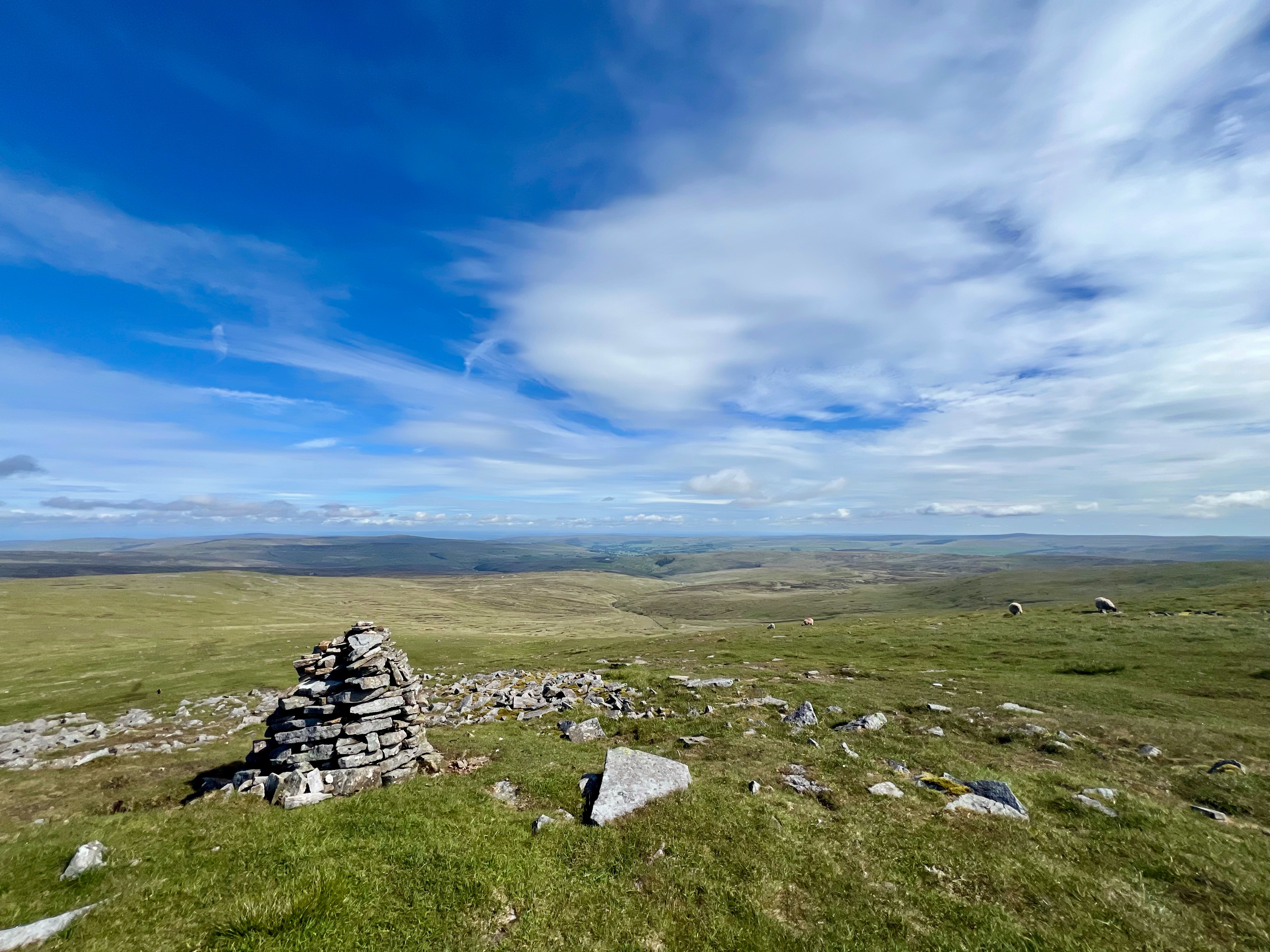
The other side of Cross Fell before the descent into Garrigil
Greg’s (no, not that Gregg’s…)
Greg’s Hut, originally a cottage built to serve the local lead mines, now stands as a mountain bothy about a mile below the summit of Cross Fell. It’s a simple stone shelter: a raised sleeping platform, a few chairs, a table & a fireplace that offers weary walkers a place to pause & regroup on the Pennine Way.
It hasn’t been long since I sheltered behind the wall on Cross Fell itself, but that stop wasn’t particularly restful. Crouching in the cold, bracing against the wind, barely counts as recovery. So when I reach Greg’s Hut, I decide to stop again.
Someone is just leaving. Once he goes, I have the place to myself.
I slide my pack off & sit on the wooden platform. Inside, it’s deliciously cool. The thick stone walls hold the heat of the day at bay; I imagine how welcome the iron stove must feel in winter. I set my alarm as a safety net, close my eyes & give myself permission to stop.
Not to plan. Not to calculate. Just to stop.
Ten minutes later, the alarm sounds. I surface slowly, heavy-limbed & reluctant. I gather my things, eat something small & step back outside. As I leave, Gilly comes in. I haven’t seen another female runner for hours & my entirely irrational competitive streak sparks into life.
I head back onto the trail with purpose.
The descent to Garrigill isn’t short; the village is still six miles away, but the path is easy to follow & in theory, perfectly runnable. As I leave the bothy, I’m looking forward to a couple of hours of simple movement. No navigation. No decisions. Just forward progress.
The track is another old miner’s route: uneven in places, loose gravel & small stones underfoot. Rel & I ran much of this back in April, despite carrying heavier packs & I expect to do something similar today. Especially as the north-eastern side of Cross Fell is far more sheltered than the southern; for once, the wind isn’t fighting me.
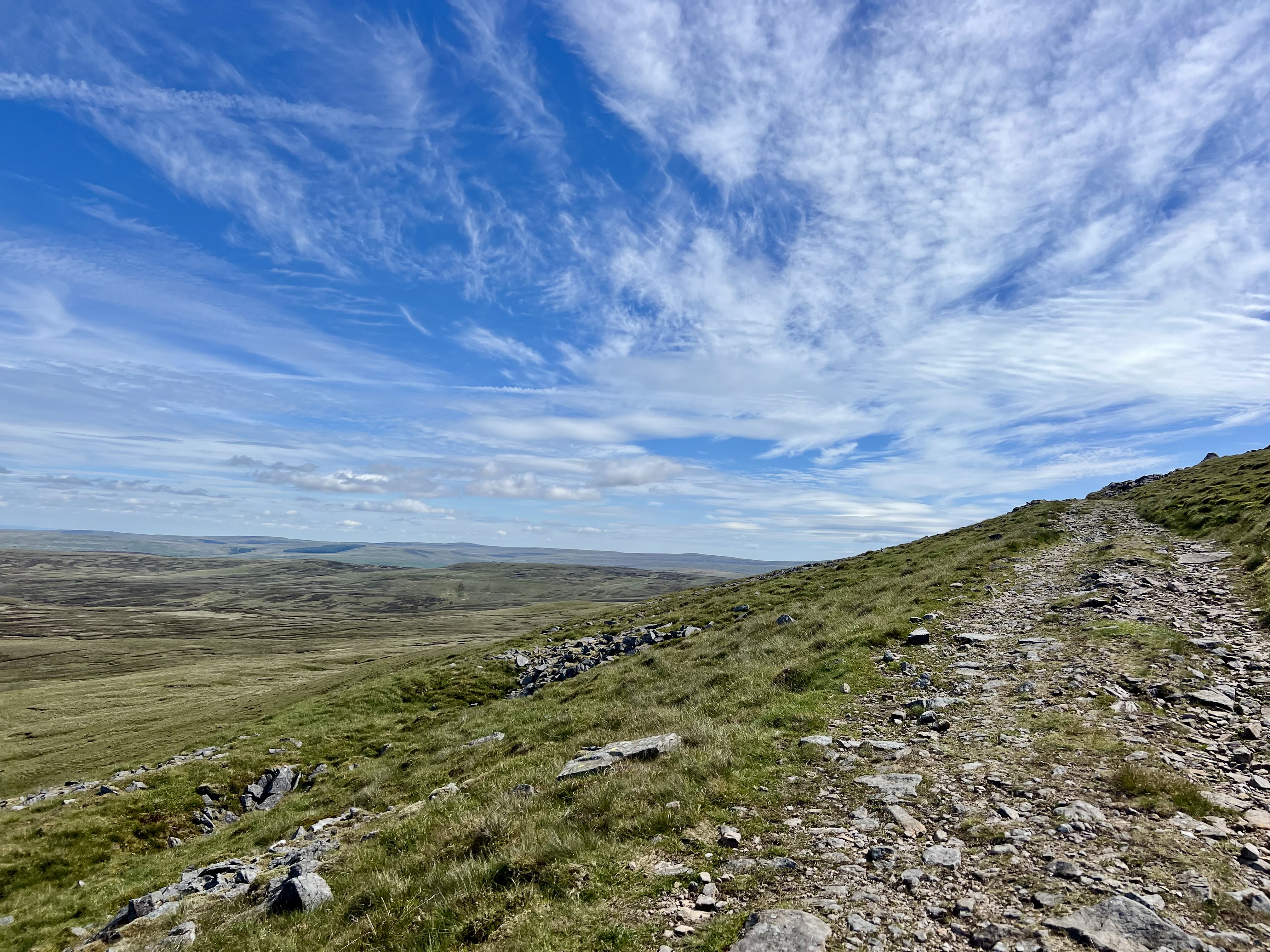
The old miners’ track
I start well, perhaps too well, & have to rein myself in when I catch myself running uphill. That familiar voice appears, reminding me that feeling good now doesn’t mean I can afford to be careless. Energy has to be managed. Something always needs to be held back.
The sky above is a deep, vivid blue, scattered with cartoon-like white clouds. Without the wind, it’s hot.
Really hot.
Then, for some unknown reason, my watch loses navigation. When I’m tired, the smallest inconvenience feels dangerously close to a catastrophe.
I manage to reload the route without stopping; a small victory.
But then I need a wee.
Then I’m too hot, so I pause to take a layer off.
Then my alarm beeps to remind me to eat.
Then I decide I don’t need my poles on a downhill & stop to put them away.
Then I need another wee.
Stop. Start. Stop. Start.
The rhythm I’d imagined never materialises. Every interruption feels disproportionate, like sand in already tired gears. I’m not just inconvenienced, I’m fraying. This is not the smooth, free-flowing descent into Garrigill I had pictured.
I pass two runners slumped by the side of the track in the afternoon sun. We exchange a few mumbled, half-formed words. No one has much to give.
I feel myself wobbling.
Trying to shift my headspace, to interrupt the slow spiral, I turn to look back towards Cross Fell. Where I have come from, not where I am going. The views are vast & beautiful, but I’m looking without really seeing. Appreciating without feeling.
In the same way, I’m running, but not really running. The ground is rock hard under exhausted feet. My stride has collapsed into an awkward shuffle & I keep clipping stones, yelping quietly with each jolt of pain. My knee is complaining loudly now, jarring with every step.
And it’s still hot.
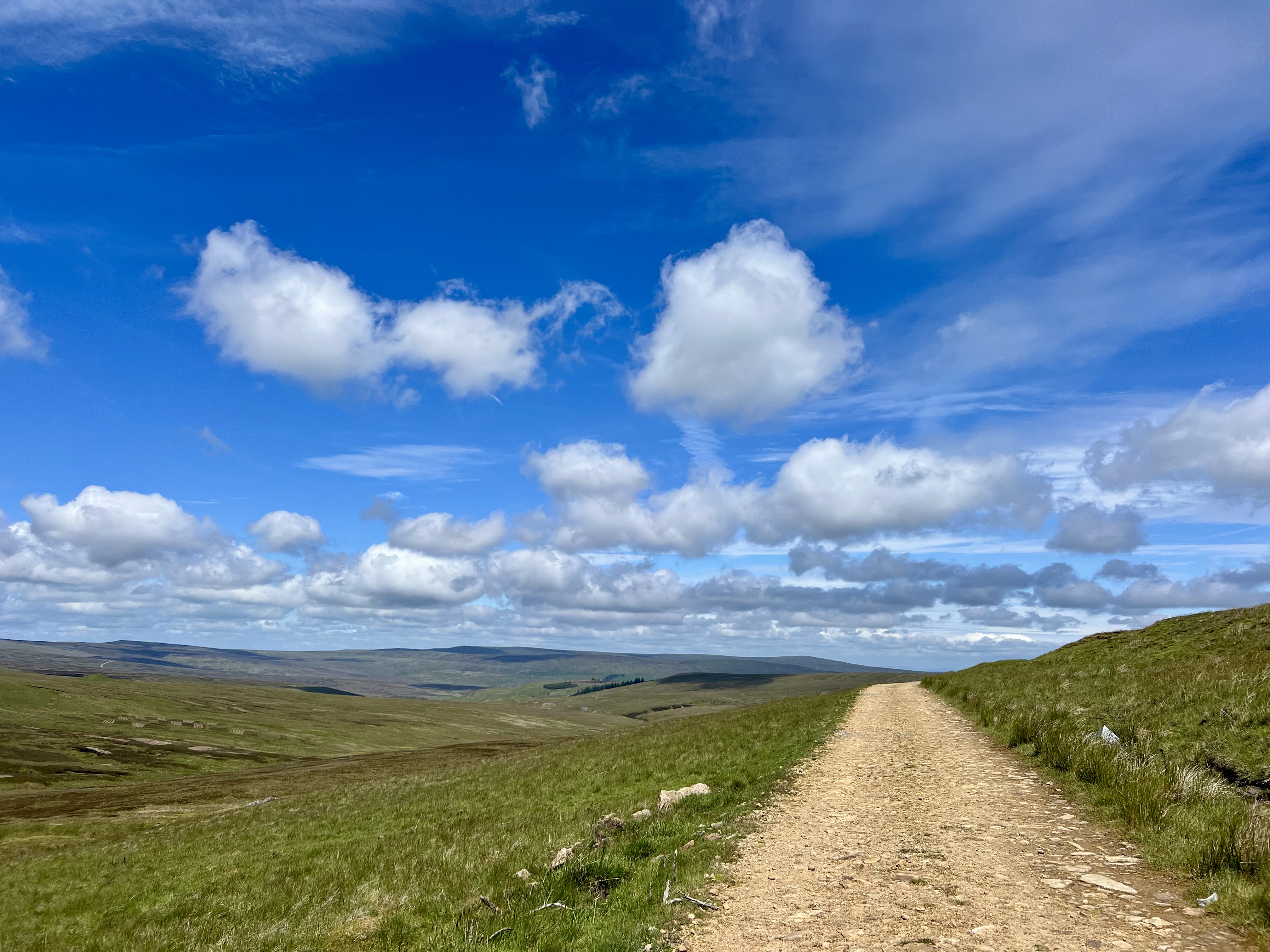
Finally, the village comes into sight. But the path, seemingly intent on avoiding it, refuses to take a direct line. My mood drops as quickly as the trail descends. I’m walking. Sweaty. Irrationally angry at the sun, the lack of shade, my knee. At the world.
Low mood, eat food. Easy advice to give. Much harder to follow when you’re the one inside the mood.
Garrigill is a small, sleepy village in the North Pennines, sitting quietly on the banks of the South Tyne. In my head, it’s just a marker: Garrigill, then Alston. Another chunk broken down. I expect nothing more than water before moving on.
What I don’t expect is Annie.
Annie
Annie, a Spine legend, lives here. Every race, winter & summer, she opens her home to Spiners. There’s even an official Spine sign outside her door & a safety team volunteer stretched out on the grass nearby.
She ushers me inside. I’m not sociable. I’m not at my best. She offers food, lots of it, including homemade soup bubbling away in a huge pan on the stove. The kitchen counters are covered in snacks & drinks. A man, I assume to be her husband, appears briefly, only to be sent straight back out with instructions to get more leeks.
It’s generous. Warm. Exactly what most people would need. But all I want is water.
She looks faintly disappointed when I decline the food & for a flicker of a second, I wonder if I should stay. Sit. Eat properly. Reset. But my mind is fixed on Alston. I don’t have the mental elasticity to change the plan now. Even kindness feels like something I have to process.
I thank her, refill my bottles & step back outside as another runner arrives & is welcomed in with the same warmth. I hope he accepts what I couldn’t.
I sit in a small patch of shade near the safety team. It’s the same guy who did my kit check in Edale, however many days ago that was. We chat briefly as I apply sun cream. Some of my foul mood on the descent was undoubtedly heat-related. Less than five miles remain to Alston, but that could still mean over an hour in full sun.
Be bothered.
(Ironically, the sun disappears not long after I leave Garrigill.)
I move through the village, past the tiny green, munching on dried fruit & salty peanuts. I’m still walking. There’s no running in me right now. But after sitting down, talking, taking my pack off & eating something real, I feel marginally steadier.
I might be walking. But I’m walking with intent again.
Just beyond Garrigill, the Pennine Way diverts to avoid a damaged bridge. Rel & I took this diversion back in April, so it’s familiar.
Back then, it felt endless. Tedious. A drag through sheep-filled fields & deserted farmyards. Nothing to look at. Nothing to distract you. Its only purpose is to avoid the damaged bridge.
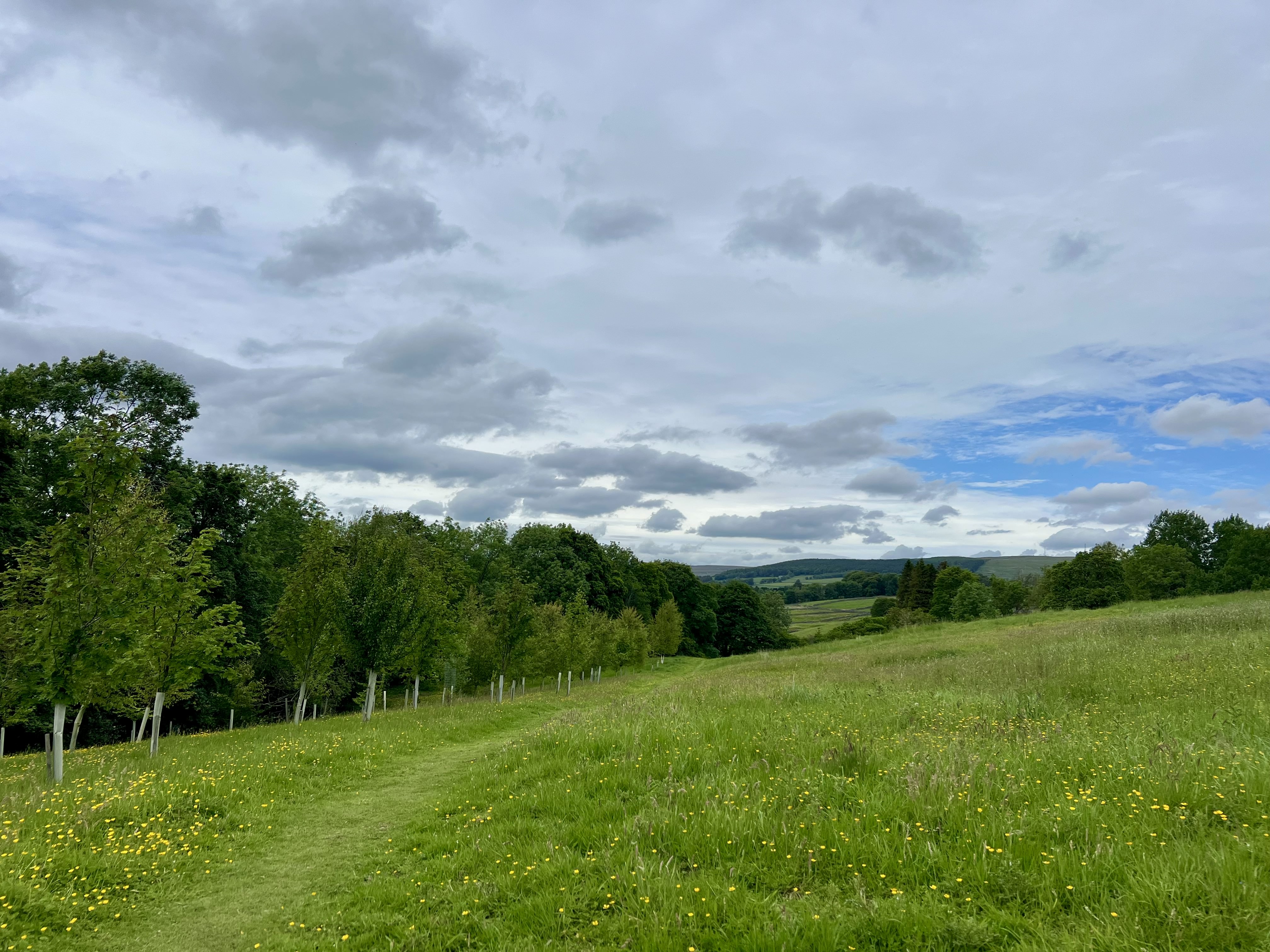
The diversion into Alston
Today, it still feels long, longer than its 4.5 miles, but it doesn’t feel quite as bleak.
There are sections of the race I had mentally labelled as problematic. Miles I remembered as unpleasant or dull. Stretches I expected to endure rather than experience.
Almost without exception, during the race, they aren’t as bad as I’d built them up to be.
There’s something powerful about preconception. When we decide in advance that something is going to be difficult or miserable, it begins shaping the experience long before we arrive. On the Spine, my own memories had quietly exaggerated certain stretches, inflating them into something worse than reality.
By the time I reached them, I’d already braced for the impact. I’d lowered my expectations. Accepted the grind before it began. And in doing so, I’d taken away some of its power.
The miles were still hard. I was still tired. My knee still hurt. But they weren’t monsters. They were just miles. And I could still move through them.
It made me realise how often the story we tell ourselves about what lies ahead is more influential than the thing itself. On the Spine, at least, the anticipation was frequently worse than the reality & once I stopped fighting the idea of what was coming, I found I could just get on with the job of moving forward.
Alston | Checkpoint Four
Checkpoint four is based in the youth hostel in Alston. A real building with solid walls & no tents anywhere.
I walk through the door and sit down on the first chair I see.
What do I want?
What do I need?
Do I want to sleep?
A shower?
Food?
“Oh, you’re 257, I’ll get the medic.”
I love the volunteers’ enthusiasm, but right now it’s too much. Everything is too loud, too bright, too immediate. I need a minute just to sit & exist.
I can’t even get my shoes off. Someone kneels in front of me & gently undoes my laces. My shoes are labelled & placed neatly on a shelf beside dozens of others.
I’m led into the main dining room. My drop bag is already waiting beside a chair. The room is busy with almost every seat taken. Bags have exploded across the floor. Runners slump in chairs, taping feet, eating, sorting kit, sleeping, leaving. Some arrive as others disappear back out the door.
After hours of solitude on the wide, empty Pennines, the room feels claustrophobic. There are more people here than I’ve seen in days.
I can’t think.
I know what I *should* be doing, but my brain refuses to engage. I open my drop bag, then close it again. Pull something out. Put it back. Pick up another item & stare at it, unsure why I chose it in the first place.
My thoughts begin to spiral.
I don’t cope well with chaos at the best of times. I’m in pain & I haven’t slept properly for four days. This is very clearly not the best of times.
I’m close to breaking down, tears hovering just beneath the surface, but I can’t let that happen here. Not in this room. Not in front of everyone. I turn inward instead. If I don’t look at anyone, maybe no one will look at me. I need space.
I ask for a bed.
The dorms are upstairs. Proper beds with mattresses (no sheets), but we’re not allowed to take our drop bags with us. Panic flares instantly. I need my system. My organisation. My bag. Without it, I feel strangely untethered.
A small part of me fractures as I try to decide what to take. Eventually, I scoop up my sleeping bag, clean clothes, electronics, toiletries, just the essentials, & carry them upstairs.
I’m shown into a six-bed dorm. It’s empty. So is the women’s shower room.
I can breathe again.
I spread my sleeping bag over a bottom bunk. Normally, I’d choose the top; I have an irrational fear of someone sleeping above me, but today, the thought of climbing a ladder feels impossible.
The shower is quick but transformative. Warm water. Soap. Steam. My first proper wash since Sunday morning in Edale, nearly four days ago.
I close my eyes & let the hot water run over my face. For a moment, everything softens. The noise in my head quiets. My shoulders drop. I feel almost human again.
Soon, I’m lying on the bunk & sleep comes instantly.
I set my alarm for three hours, hoping for two full sleep cycles. Instead, I wake after less than two hours. I fell asleep alone. Now two other women are in the room. Gilly sleeps soundly. Bev is settling into her bed. I didn’t hear either of them arrive.
I lie still, wondering if I can drift back to sleep.
Almost immediately, my brain switches back on, loud, insistent, running through a checklist of everything I haven’t done.
My checkpoint routine is always the same: eat, sort kit, prep pack, fill bottles, change clothes, freshen up, *then* sleep. I do it this way because I know myself. I can’t rest with unfinished tasks.
But earlier, overwhelmed, I skipped all of it. Now panic creeps in. I know I won’t sleep again, even though I still have nearly three hours before I need to leave.
Sometimes, I really hate my brain.
I gather my things & slip quietly downstairs. The rush has passed. The room is calmer now, quieter. Someone guides me to a different chair tucked slightly to one side, with space around it.
Relief washes through me.
I eat another plate of beans on toast. To my right, two members of the media team chat about photography. I half-listen, half-wanting to join in, drawn toward something familiar & normal.
Even with fewer people, the overwhelm lingers, just beneath the surface.
The medics examine my knee. It’s badly swollen but structurally fine. They remove the K-tape from Middleton, apply anti-inflammatory gel & hand me two codeine tablets; one for now, one for later.
Then comes the difficult conversation. After talking it through, I agree to stop running & to walk the rest of the race.
The decision hurts almost as much as the knee.
One of my goals had been to run as much as possible, all the way to the finish. Irrationally, I feel like I’ve failed. Everything else feels strong enough. Capable enough. It’s just this one bloody knee.
But finishing matters more. I know that. If walking the remaining eighty-odd miles to Kirk Yetholm is what it takes, then I will walk eighty miles to Kirk Yetholm.
Still, the change of plan unsettles me. Over-organisation has a downside: when the plan changes, I struggle to adapt. Aware I’ll be slower, I decide to carry more food, but suddenly I can’t decide what or how much. Soon, most of my drop bag is spread across the floor.
Exactly the checkpoint faff I’d worked so hard to avoid.
My system had been simple. Everything labelled. Everything pre-packed. Clean clothes per section. Measured food bags. No decisions required. Arrive. Change. Swap. Go. No thinking.
Except now I have to think.
A volunteer comes and sits beside me, a Spine old-timer who has finished the race multiple times. My imposter syndrome flares immediately. I feel exposed, slightly unravelled. I wonder if he can see how close I am to falling apart.
My bottles sit in front of me, filled, as always, with more than 2.5 litres of water.
He gently tells me I don’t need that much for the next section. Evening is coming. It’ll be cooler. There’s a tap seven miles ahead, another at Greenhead ten miles after that.
“One litre will be plenty,” he says quietly.
Reluctantly, I pour the rest away.
It feels like letting go of a safety net.
But when I shoulder my pack, now 1.5 kilos lighter, it settles easily against my back. Almost floating.
And for the first time in hours, it feels manageable again.
- Checkpoint 4: Alston.
- Distance Covered: 180 miles
- Arrival time: 14:39:02, Wednesday 18th June.
- Race time: 78:38:47
- Time in checkpoint: 05:30:30
 Photo Girl Runs